


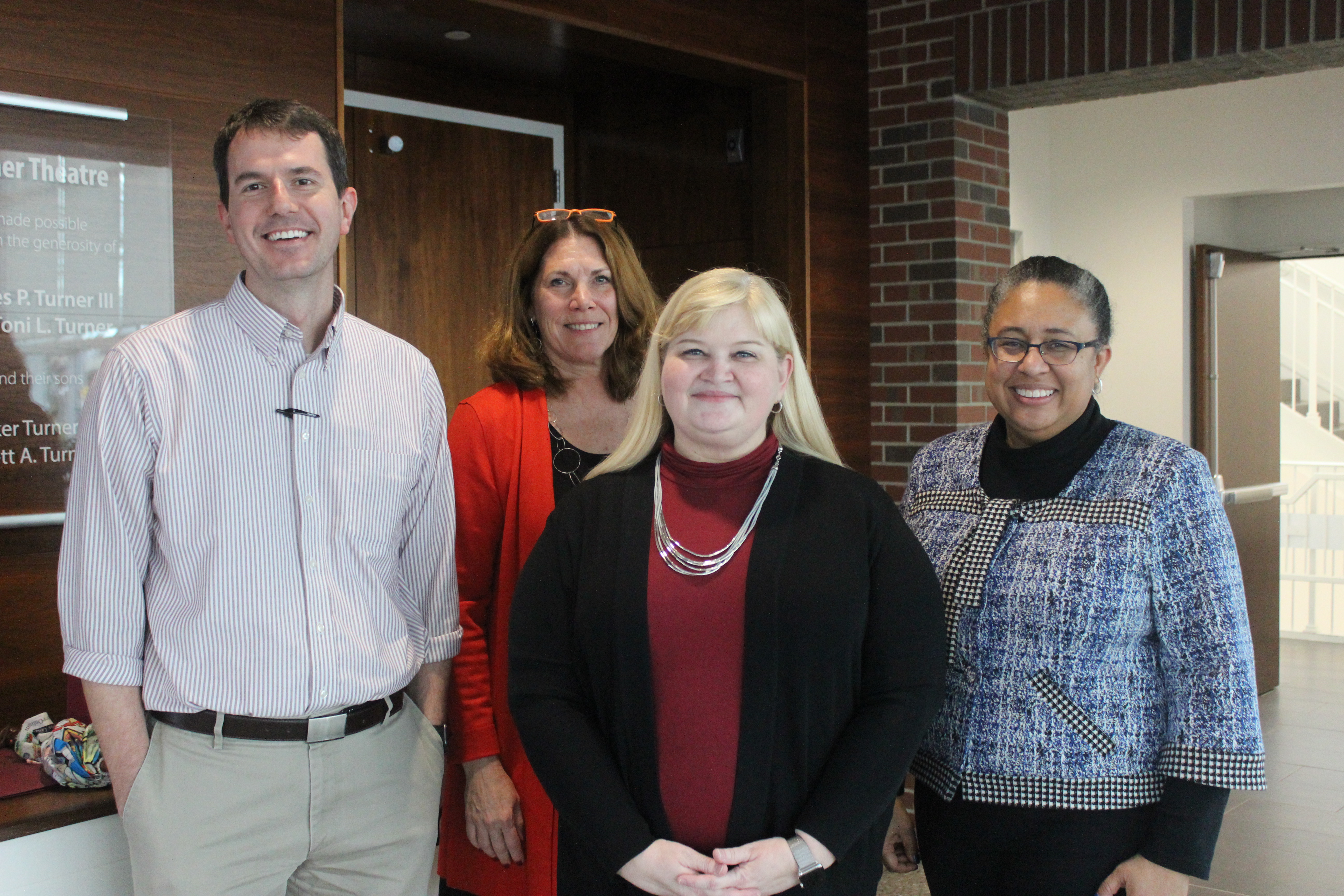
Sara Glines and Robyn Tomlin from publishing company McClatchy joined 榴莲app官方网站入 students Jan. 14 to talk about some of the challenges facing local journalism and how the industry is adapting.
Two regional leaders from McClatchy, a publishing company headquartered in Sacramento, California, visited 榴莲app官方网站入 Jan. 14 to discuss the difficulties local journalism is facing and how to combat public criticism of the industry. The company operates media outlets in 30 markets around the country with more than 65 million readers each month combined.
Sara Glines, president and publisher of the Raleigh News & Observer and the regional publisher of the Carolinas and East regions for McClatchy, and Robyn Tomlin, the executive editor of the Raleigh News & Observer and Durham Herald-Sun and southeast regional editor for McClatchy, gathered with 榴莲app官方网站入 students from a variety of journalism-focused classes, and advised them聽not to be discouraged by the challenges they may face in their future journalistic endeavors.
Each day in the newsroom poses its own unique challenges, Tomlin said. Many newsrooms face public criticism and accusations of 鈥渇ake news,鈥� along with more serious dilemmas.
鈥淲hat we get accused of sometimes is not publishing the story from the perspective that the person who is making that criticism believes is true or accurate,鈥� Tomlin said. 鈥淧eople like to call that fake news.鈥�
Glines noted that reporters must be cognizant of how readers may perceive the content they post online. She suggested reporters refrain from publicizing their own political views. But even when reporters remain unbiased, public criticism continues to be a pervasive issue, Glines said. It鈥檚 one of the reasons Tomlin said reporters must have 鈥渁 few extra layers of skin.鈥�
Throughout their careers, Glines and Tomlin have developed their own thick skins as women in an industry historically dominated by men. That’s another reason Glines, Tomlin and many others have worked toward greater racial, ethnic and gender diversity in newsrooms.
鈥淚t鈥檚 a priority because we have to reflect the communities that we serve,鈥� Tomlin said. 鈥淭hat鈥檚 important for us – to really make sure that we are focused on reaching every corner of our community.鈥�
During the hour-long discussion,聽Tomlin and Glines covered other topics about the industry including ethical issues, libel cases, audience engagement, multimedia, economics and more. Glines noted the ways the field has changed since she began her tenure as a journalist and subsequently as an advertising executive.
鈥淚 think that it has become a much more holistic environment than it was 20 years ago,鈥� Glines said. 鈥淎nd I think it has to be.鈥�
Glines described the current state of the industry as experiencing a 鈥渢ransitory period,鈥� quickly shifting from print to digital news, which has greatly impacted the business side of journalism. 鈥淭he economics of local journalism have changed significantly,鈥� Glines said.
Print advertising used to sustain newspapers financially, but not anymore. Now, there exists a conundrum in which large audiences exist online, but a successful business model does not, Glines said. As a result, newspapers have to rely on limited digital solutions, such as moving toward paid online subscriptions for content that, in many cases, was previously free.
Tied to the financial aspect of digital content is analytics, which plays a large role in the day-to-day digital news cycle. 鈥淭he analytics are a big driver of how we cover what we cover and how we know that we鈥檙e reaching the right audiences,鈥� Glines said.
Glines and Tomlin said they believe that analytics has become almost necessary to how a newsroom functions because of the valuable information the numbers provide reporters and editors, including statistics on audience retention, readership and overall success of content.
“Ultimately, we really want people to engage with the work that we do, and so, using analytics helps us to do that,” Tomlin said.
Despite the challenges and hardships facing journalism, Glines and Tomlin remain excited about an industry that plays an important role in society, noting that the industry isn’t going anywhere.聽Tomlin shares that at the Raleigh News & Observer, there has never been a larger audience than they have today as they receive 3.5 million unique visitors a month.
鈥淟ocal news organizations will always be around,鈥� Glines said. 鈥淲e know our mission in our community, we know how important it is that we are there, and we know that there is a path forward and a business model to support something as important as local journalism.鈥�
She concluded the discussion by encouraging students considering futures in journalism. 鈥淎s you look forward in your career, don鈥檛 be scared off by something that seems difficult,鈥� Glines said. 鈥淟ocal journalism is an incredibly rewarding and important career.鈥�
Sonya Walker ’20 contributed to this article.