


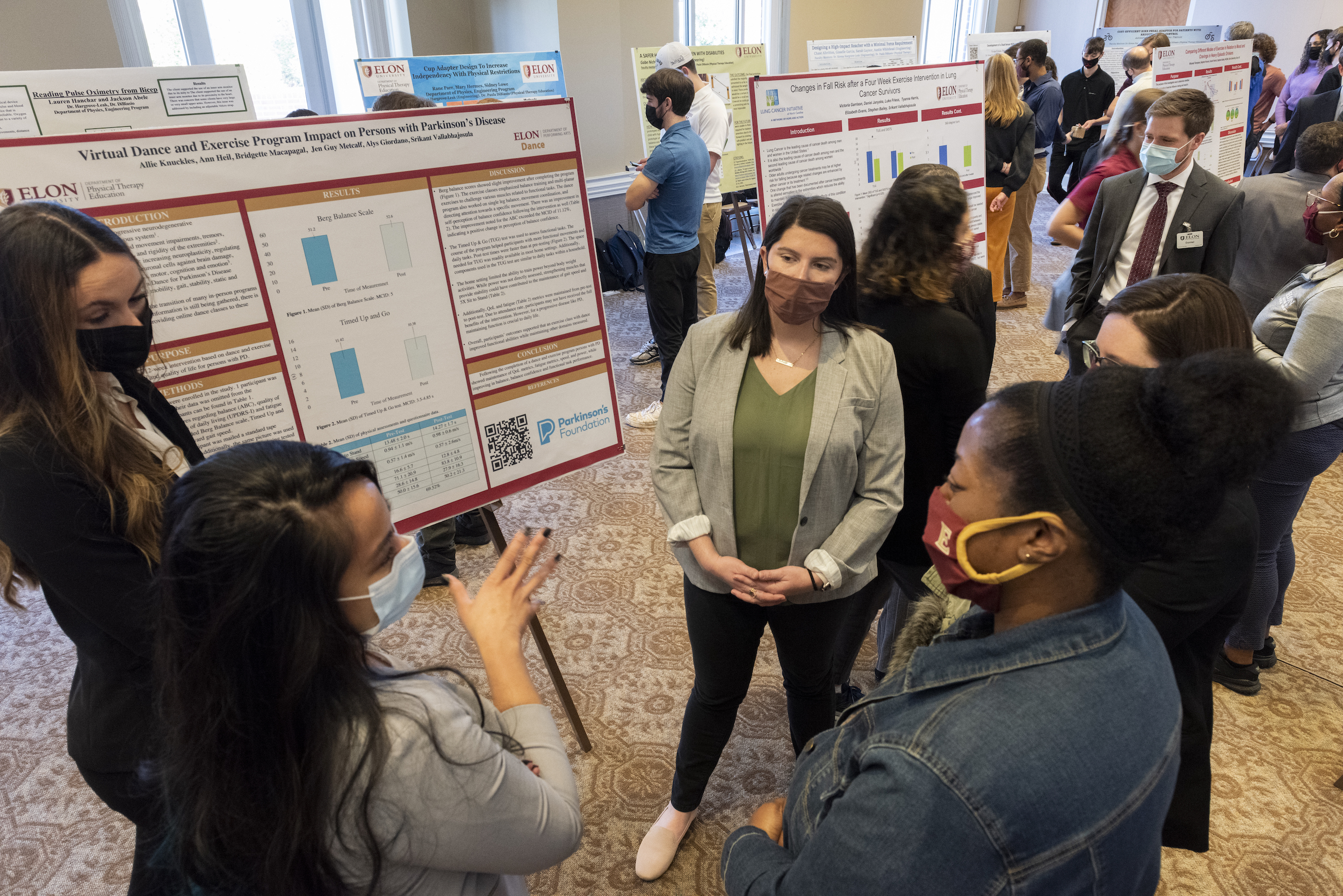
Students from the Doctor of Physical Therapy, Master of Physician Assistant Studies and Nursing programs, along with undergraduate engineering students, shared their research during the forum at McKinnon Hall inside Moseley Center.
Nearing the end of their journey, dozens of 榴莲app官方网站入 future physician assistants, physical therapists, nurses, engineers and other professionals presented their research projects on Dec. 7 at the School of Health Sciences’ third-annual Global Engagement and Research Forum.
“It’s a great opportunity. There are so many interesting topics and people worked really hard on their presentation. I’m honored to be here and get to share what I’ve learned and … show people that there are interesting things happening,” said Christina Walters PA ’21, who presented her research on pharmacogenetic testing and the future of major depressive disorder treatment.
The gathering was an opportunity to showcase the results of collaborations across 榴莲app官方网站入 campus, as well as the engaging experiences students have learned from while studying abroad. Fifty-three projects 鈥� 19 from second-year Physician Assistant Studies program students, 16 from first-year Doctor of Physical Therapy program students, 10 from students who participated in Global Learning Opportunities and eight engineering students 鈥� were presented at the symposium in McKinnon Hall inside Moseley Center. The projects ranged a variety of issues from the long-term effects of COVID-19 to the accuracy of virtual reality methods in physical recovery, and everything in between.
 Grant Janicik DPT 鈥�21 and Makena Mueller DPT 鈥�21 centered their research on gaining insight into practicing physical therapists鈥� understanding of and confidence in treating long COVID and identifying the most common symptoms seen in those with long COVID.
The study aimed to increase the available data on physical therapist management of treatment for patients with long COVID. Janicik and Mueller sent out a survey and received over 362 physical therapists. Of those surveyed, more than 80 percent reported seeing patients with long COVID but only 20 percent used outcome measures recommended by the American Physical Therapy Association.
They found that physical therapists who did not receive structured education reported having a personal experience working with long COVID, either directly working with patients or having a previous diagnosis of long COVID. A significant difference was found in perceived confidence level between physical therapists who completed continuing education (43 percent) on long COVID and those who didn鈥檛 (26 percent).
鈥淭he education needs to be much higher to get that confidence level much higher,鈥� Janicik said.
鈥淥ne of the big things we did find was that PTs who did complete some form of continuing education in regards to COVID-19, or long COVID in general, had more confidence in treating patients with long COVID,鈥� Mueller said. 鈥淎nd most of those who did complete education, completed it on their own through their own research, rather than through their employer.鈥�
Stacey Walton DPT 鈥�21 and Oliver Tuisa DPT 鈥�21 researched obstacle crossing in mixed -eality environments compared to virtual and physical environments.
Walton and Tuisa worked with 12 healthy, young participants and observed them crossing a 15-centimeter obstacle in physical reality (PR), virtual reality (VR) and mixed reality (MR) settings. Previous research has shown that VR and MR can be beneficial and cost-effective tools for PT assessment for populations with higher risks of tripping during activities of daily living.

They discovered that when using MR and VR systems, there is a greater height of the leading leg while clearing obstacles but a shorter peak height in the trailing leg. Walton and Tuisa concluded that the shorter peak height in the trailing leg of MR and VR may be attributed to the lack of feedback if not cleared or the perception that the obstacle is not real and the chances of tripping are lessened.
Both said that the past year spent conducting this research was difficult, but it was rewarding to garner the experience of creating an extensive research project from scratch.
鈥淚鈥檝e always got onto a project that鈥檚 already started 鈥� whereas this time, we built it from the ground up. It was a very lengthy process, but it ended up being very beneficial,鈥� Walton said.鈥�
Continuing education
Tuesday’s symposium was just one event leading up to聽the combined School of Health Sciences commencement on Saturday, Dec. 11. The Elon Department of Physical Therapy Education held its annual two-day continuing education course this week that was attended by graduating third-year students, department faculty and community partners鈥� including alumni and clinical instructors. The course is planned by Assistant Professor of Physical Therapy Education Shefali Christopher.
This year鈥檚 course, 鈥淭ransformative, Equitable and Inclusive Practice in Physical Therapy,鈥� was an interactive program with 100 attendees and taught by Tiffany Adams 鈥�10, an Elon graduate and current Duke faculty member, along with Mica Mitchell from Methodist University.

鈥淲hat a thrill to have been invited to return to my alma mater to provide the annual continuing education course,鈥� Adams said.
Wes Rissell 鈥�16 is currently a physical therapy at Cone Health Alamance Regional Medical said, 鈥淭he course was collaborative, interactive, and thought-provoking.鈥�
This two-day course invited attendees to perform root cause analysis and think about themselves and their organizations in a shared and thoughtfully curated and evidence-based conversation.
鈥淚鈥檓 graduating on Saturday, and this was a very enlightening experience that will definitely promote inclusivity in my upcoming career,鈥� said Liana Solomon, a third-year student who will earn her DPT degree on Dec. 11.
According to Mary Kay Hannah, assistant professor of physical therapy education, the central theme of the course was, 鈥淒iversity is a fact. Inclusion is a behavior. Equity is the goal.鈥�
 Hannah, who also serves as president of the American Physical Therapy Association North Carolina chapter, noted that with only 4% of all PTs being Black, the profession is working at the national, state and school program levels to promote physical therapy to less-represented communities with the goal of increasing diversity.
鈥淲e hope that our profession ultimately looks more like the communities we serve,鈥� Hannah said.