


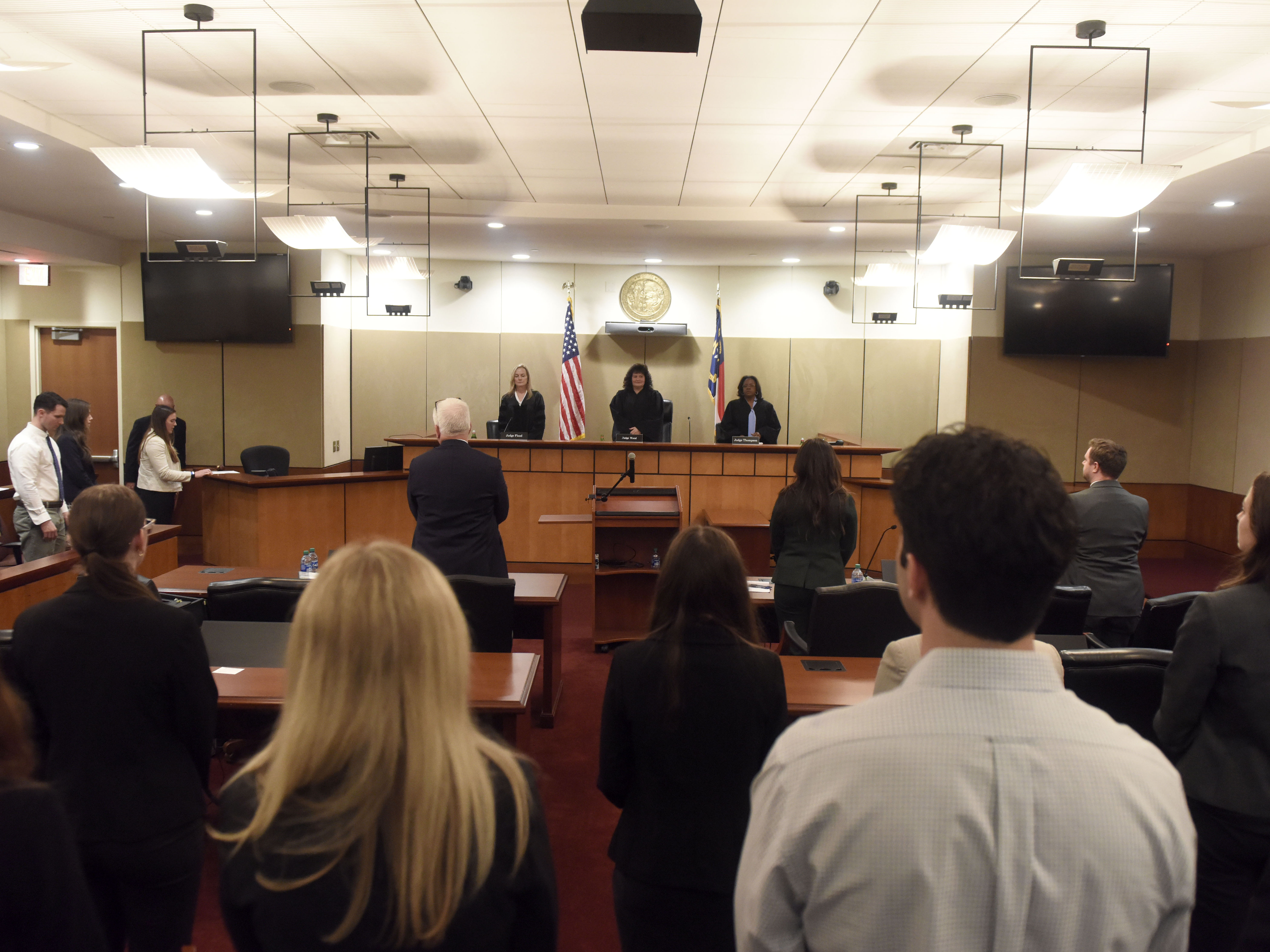
Judges visited with legal writing classes and dined with students interested in clerkships before oral arguments in two cases soon to be decided: the first involving a drug trafficking conviction, and the other a question of attorney fees in a lawsuit brought against an employer.
A recent visit to 榴莲app官方网站入 School of Law by the offered more than an avenue for students to observe appellate advocacy in real time.
It also provided them an opportunity to learn directly from some of the state’s leading jurists, including a former member of the Elon Law faculty.
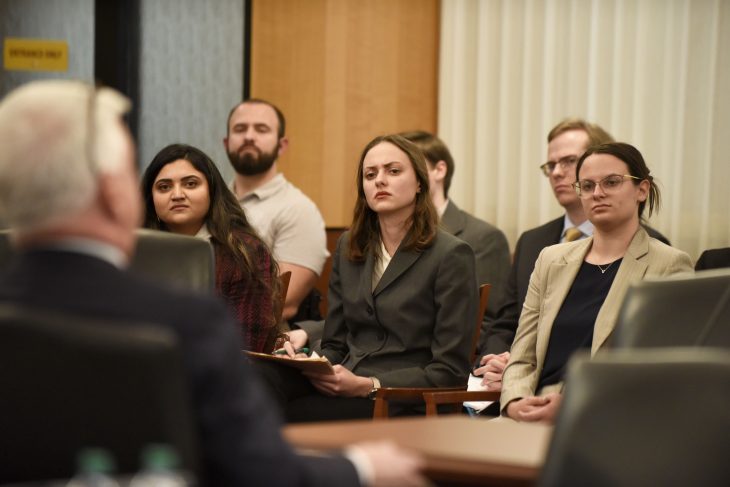
Judges April Wood, Jefferson Griffin, and Julee Flood heard arguments on April 9, 2024, in , which involved questions of whether a trial court erred in not dismissing drug trafficking charges in a case out of Randolph County where the defendant never took independent possession of a package containing methamphetamine.
The same appeal also challenged the trial court鈥檚 decision not to inform the jury of the lesser offense of attempted trafficking in methamphetamine by possession.
Wood and Flood were joined later in the afternoon by Judge Carolyn Thompson to hear arguments in In that appeal, a woman had won a jury trial against an employer who failed to pay earned commissions. Despite the win, lawyers argued that a trial court erred in not also awarding attorney fees.
Arguments took place in the Robert E. Long Courtroom inside 榴莲app官方网站入’s downtown Greensboro law school. A Q&A was moderated afterward by legal writing faculty members Srikanth Reddy and聽Megan Reilly-Dreas L鈥�21, an administrative clerk for Flood teaching this spring at Elon Law.
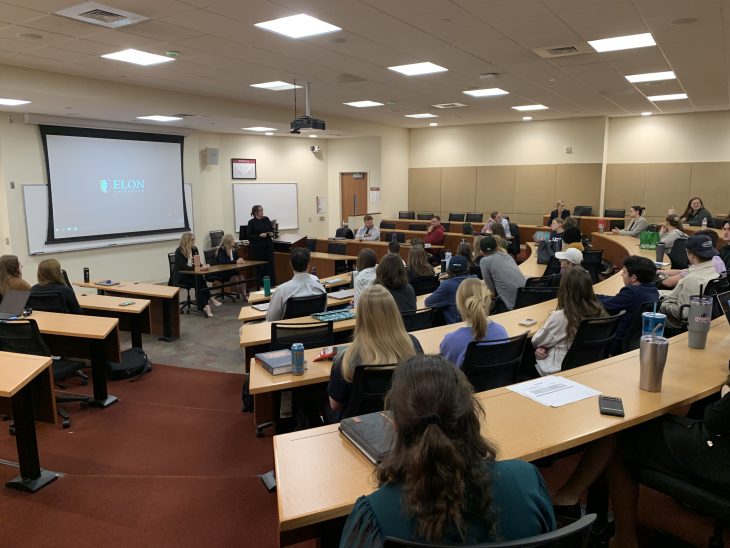
Flood and one of her other law clerks, Elon Law graduate Emily Erickson L鈥�22, visited with legal method and communication classes shortly after their arrival and before the afternoon hearings. Among the questions students posed to Flood, who once served as a Legal Method and Communication Fellow at Elon Law: how do you handle cases where, when applying the black letter law, the outcome does not align with what you鈥檇 consider to be fair or just?
Flood鈥檚 reply? It’s not her job to make the law or inject her personal opinion but to apply the law as written and follow that to its logical conclusion.
鈥淚f you looked closely enough,鈥� Reilly-Dreas said, 鈥測ou could see lightbulbs popping up over the heads of several students when Judge Flood said it was the job of the legislature to make the law and it was her job to apply the law as written.鈥�
Professors said the judges鈥� visit to Elon Law illustrated for students the relevance of what they鈥檙e now learning in the classroom.
鈥淎ttending oral arguments really helps students understand the importance of thorough legal research and careful, persuasive writing in legal practice,鈥� said Assistant Professor Caroleen Dineen, director of Elon Law鈥檚 Legal Method and Communication Program. 鈥淚n addition to watching attorneys advocate for clients, students interacted with judges to learn more about what they do and how they evaluate briefs and oral arguments.
鈥淭he valuable information that judges shared about tips for effective legal writing, preparations for oral arguments, and traits they seek in law clerks will be of lasting benefit to students who may one day want to serve in those very same judicial roles.鈥�
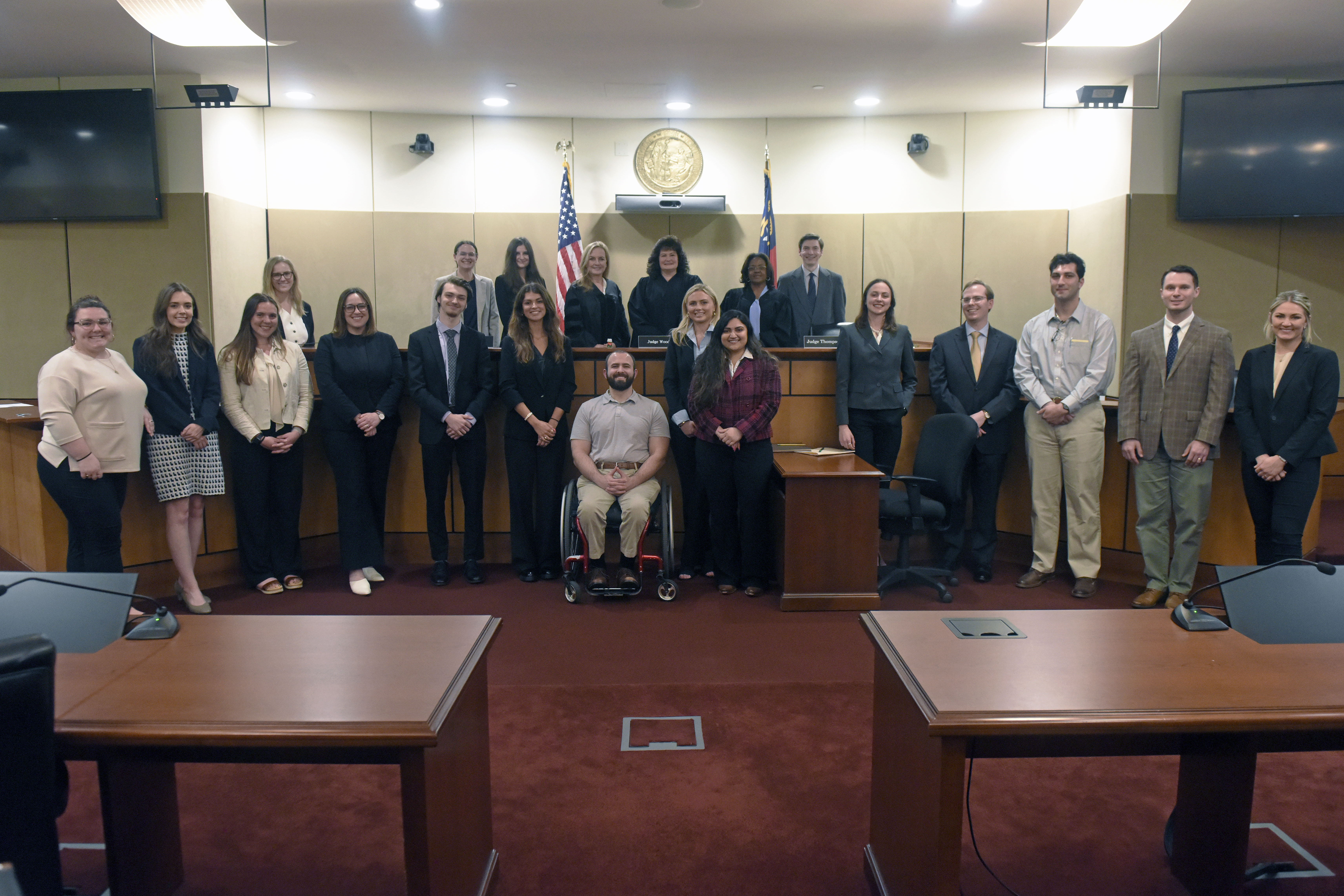
Student Reflections
- 鈥淚 felt it was valuable watching appellate judges for the first time. I don鈥檛 think I would have had this opportunity anywhere else. Hearing how they responded to arguments, and hearing their reactions and their answers to students, was incredible.鈥� – Frank Edwards L鈥�25 of Smithfield, Va., a graduate of George Mason University
- 鈥淲hat I really took away from the Court of Appeals visit was the aspect of law we don鈥檛 necessarily get to see in the classroom. Watching judges interact with not just lawyers or the brief, but with the laws themselves, and seeing things unfold in real time on your feet, wasn鈥檛 something I鈥檝e been exposed to.鈥� – Dmitri McKinney L鈥�25 of Elon, N.C., a graduate of North Carolina State University
- 鈥淭he judges being here at Elon was amazing. They helped students see what happens at the Court of Appeals and how much work it takes. I also loved seeing attorneys in their moment, in their zone, answer questions and know their subject backward and forward. They鈥檒l take the same law and show their perspectives and persuade the court which side is correct.鈥� – Aashna Tarasaria L鈥�24 of Greensboro, N.C., a graduate of UNC Greensboro and High Point University (MBA)